Emerging
Artist
Africanis, Afrikaner

Meet Joe; he is an Africanis, a mixed breed dog unique to South Africa. Meet Jacobus; he is an Afrikaner, a white male unique to South Africa. Jacobus and I, an English South African who can barely string an Afrikaans sentence together, have been in relationship for over six years.
Here we are at the Witsand resort in the Western Cape, waiting for the keys to our weekend huisie. In South Africa, historical segregation informed the landscape we live in; today it is still prevalent in the spatial apartheid of the city street system that cuts off townships, and in holiday towns such as Witsand where language defines culture and accessibility.
Sasol New Signatures 2026 Finalist
‘Africanis, Afrikaner’ taps into the tradition of documenting ‘Afrikaners’ in varying ways, from photographers David Glodblatt, Roger Ballen and Roelof van Wyk to literature like The Last of the Afrikaners by Hermann Giliomee, a book that Jacobus worked on as a researcher at Stellenbosch University in the 2010s. My perspective is that of a newly recruited outsider (there is still a lot of animosity towards English people, something I was not aware of before).
From the inside of the car - I will get sunburnt if I’m outside - I watch as Joe scratches, Jacobus tans; the sun beats down, the wind howls, the grass gets drier. In the bottom left, there is a small entjie, discarded by the Afrikaner. There is humour, curiosity and love. This is my new family, my Africanis and Afrikaner.
Synaesthesia

Speak, Wind
The series explores synaesthesia – the blending of senses - through limitations. Old film generates noise, the frame enforces stillness, and the B&W eliminates associations with colour, creating a synaesthesia response in the viewer. Printed A0 the senses overwhelm.
Listen, Midnight
The photographs are shot on 47 year-old expired B&W film with a simple point and shoot Pentax. The expired film conceptually links to noise, more often used to explain unwanted imperfections.
The exaggerated grain is a contrast to today’s hyper-real digital images. Software like Photoshop, AI, and digital manipulation tools want us to clean up images. Here, the grain invites the viewer to lean in, to hear the wind speak, to listen to the sounds of midnight insects that tremor nighttime leaves, to imagine the murmurs of early spring flowers pushing through loam.


Murmur, Spring
Printed A0, the size disorientates the viewer experience; from a distance the visual is easy to understand, but up close the grain overwhelms, creating an abstract pattern. The black-and-white palette pushes the multi-sensory imagination, too. The viewer is free to assign their own colour and sensory, synaesthetic smash-up.
Rupert Museum, AbstRacT – Synchrony Revealed
Edition of 5
Photograph on Felix Schoeller True Fibre 200gsm
94,5 by 128,5 by 5cm
The Circus Horse
Cirque de Zavvata, Bretagne, France

It’s 2008. A circus pony goes round in circles. And again. The photograph, shot seventeen years ago and printed in 2025, closes the gap between then and now. The pony is stuck in the eternal instant. The audience applauds.
.
My mom and I were in France on a riding holiday, exercising thoroughbreds in the mornings, and wandering around the chateau grounds and nearby village in the afternoon. For over three hundred years, French artists have documented the circus; the list includes Degas, Renoir, Seurat, Toulouse-Lautrec, and Chagall with his famous ‘Le Cirque’ series.
Nouveau Cirque Zavatta arrived one Tuesday afternoon during our holiday. Working with limited means – a Kodak disposable camera, no flash, too much movement – meant the light inside the tent was out of my control. In the end it works because it captures the scruffiness and low-fi wonder of a regional circus.
Photography asks us to believe the image is true, that every captured moment in time is de facto. But the circus is about illusions, as is photography. In this performance the circus pony had been gussied up to resemble a small lion. The reframing pushes the entrapment further, confining the pony’s performance to another box. By printing and presenting it seventeen years later, the pony re-performs its routine, forever and ever.

Portrait
of a big
summer
No notes.

Grey Horse, Brown Mud,
Hout Bay

Flowers of Mary,
in her kitchen.
Memorial, Onrus


κούφαλο κοτόπουλου
(skeletos kotopoulou)
Athens Food Market
Petrified.

Hallelujah, Leonard Cohen
Lot-en-Garonne, France


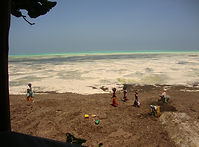
Macroalgae
Zanzibar women collecting kelp. Part of a larger project I am working on about seaweed, kelp, saragossa, and changing shorelines.




Roses & Tyres, Nairobi
I: Orange & Yellow
II: White & Blue
III: Pink & Blue
Notes: These roses are a WIP, currently printed as A5 postcards. I am experimenting with painting them with watercolour (this is one of the original photos).
Kenya was colonised by British Settlers in the late 1800 and early 1900s. They brought their gardens and roses, trying to inflict an English identity on African land. Because flowers grow from seeds, they are always connected to the first iteration. Many of Kenya's roses are natural heritage roses, as the genus has died out elsewhere.
Today, it is a thriving industry: Kenya makes up 16% of global flower trade, half of which are roses. Kenyans grow their own roses in any land, cultivated in the urban landscape, rugged and delicate at the same time. The photographs in the series were taken at a mechanic's shop in downtown city.

unknown grave of an unknown slave(s)
new project documenting the slave burial sites of early cape colony


Verlep, Lockdown Level 5
Athena

Sunset at the Acropolis,
Athens, 2016


Bougainvillea in peach
& Bougainvillea being cerise
Kefalonia, 2016
(two photographs framed)
Sea Point pool
.jpg)
Here comes the storm,
Antibes


Summer on the Côte d'Azur, Antibes

Late Summer, Main Road, Sea Point